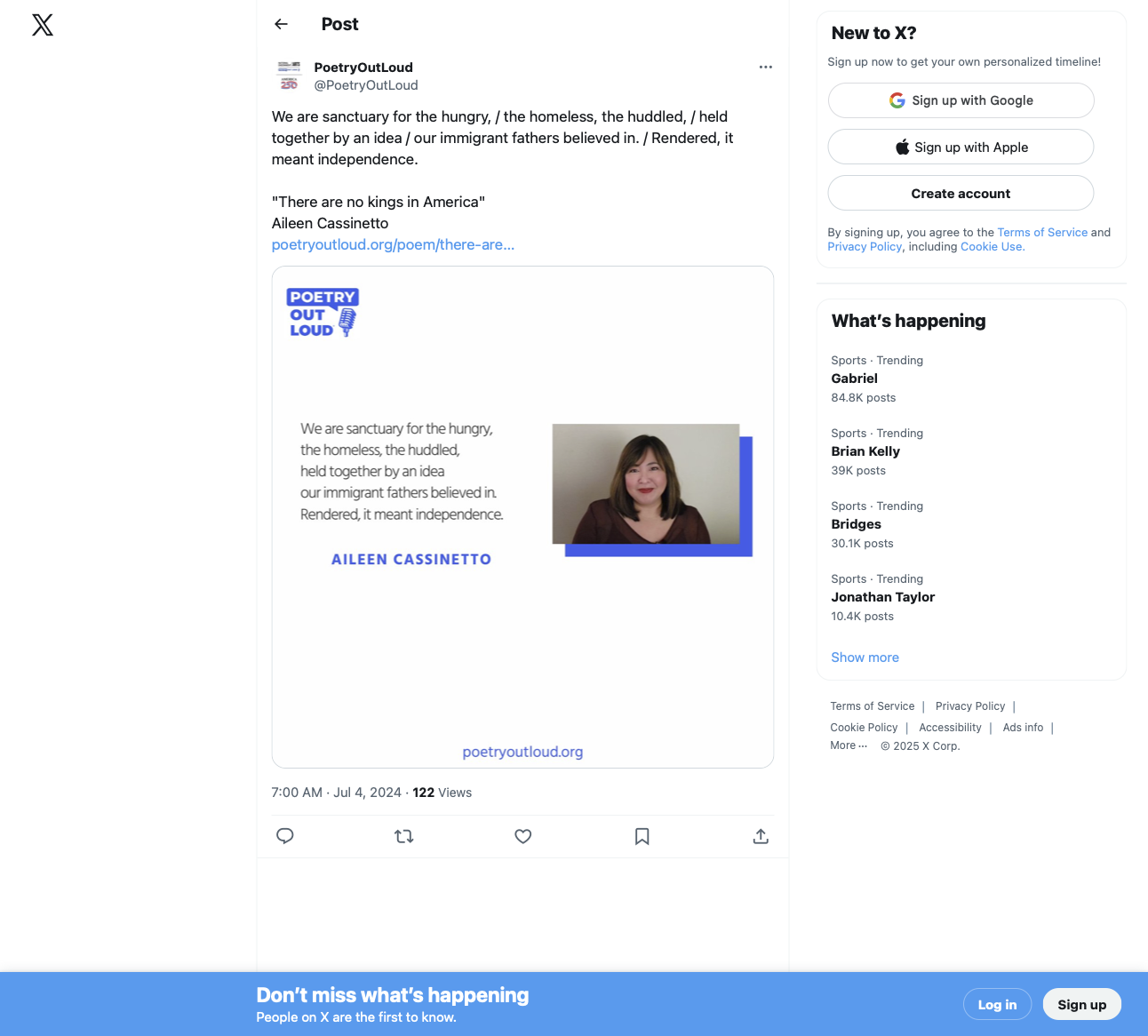
“There are no kings in America” was first presented at the County of San Mateo’s Board of Supervisors Meeting on July 9, 2019 in keeping with the poet laureate’s duty to open quarterly sessions with an original poem. It has since been published in Vox Populi (2020), poets.org (2022), and Poetry Foundation (2023).
In 2022, it was featured in the Academy of American Poets’ multimedia education project, Dear Poet, and selected by the U.S. Consulate General in Shanghai as their official Independence Day poem.
In 2023, since its inclusion in the Poetry Out Loud program, the poem has been performed annually by high school students nationwide and featured at various public readings including the Gettysburg College Baccalaureate Service.
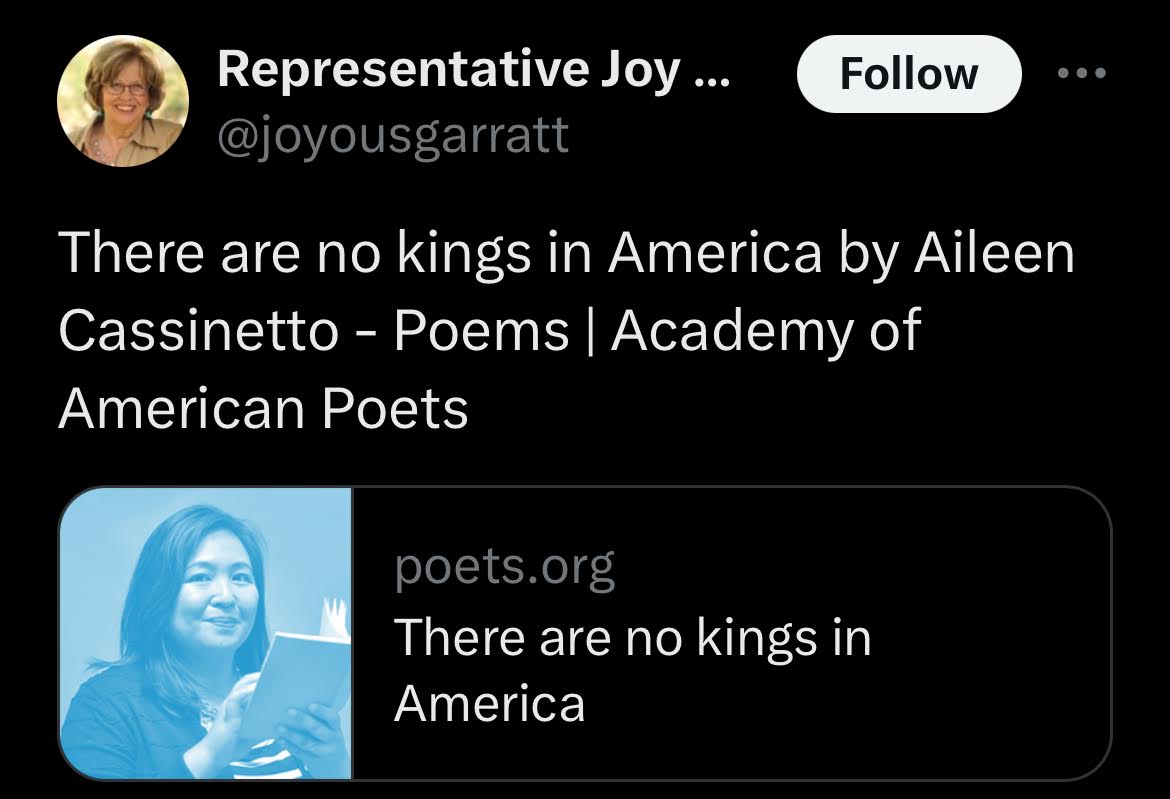
It circulated widely on social media following the Supreme Court’s landmark decision 603 U.S. 593, and on February 19, 2024, U.S. Senator Tammy Duckworth and New Mexico State Representative Joy Garratt each quoted lines from the poem in public statements. The poem has also been reproduced in postcards, placards, and other popular media.
On April 19, 2025, it was featured in a printmaking exhibition as part of the 250th anniversary of the American Revolution in Concord, Massachusetts. On June 14th, Actor Amanda Brugel shared the poem on Instagram to mark No Kings Day. On October 18th, the poem appeared at a No Kings protest in New York as non-commercial movement iconography where a participant was photographed by poet Will Nixon wearing it as a cape (photo below).
At its heart, the poem is about the tension between America’s founding ideals and the way they have been reshaped over time. Inspired by the 1776 reading of the Declaration of Independence to the Continental Army, the poem is a commentary on how our actions today compare to the principles adopted by the Second Continental Congress. No one comes to America without believing in the American Dream; the issue is that the American Dream has been redefined so many times over the last one hundred years. While it is now often linked to wealth and success, it was originally about equality, justice, and democracy, and the belief that beyond geography, land makes identity and belonging possible.