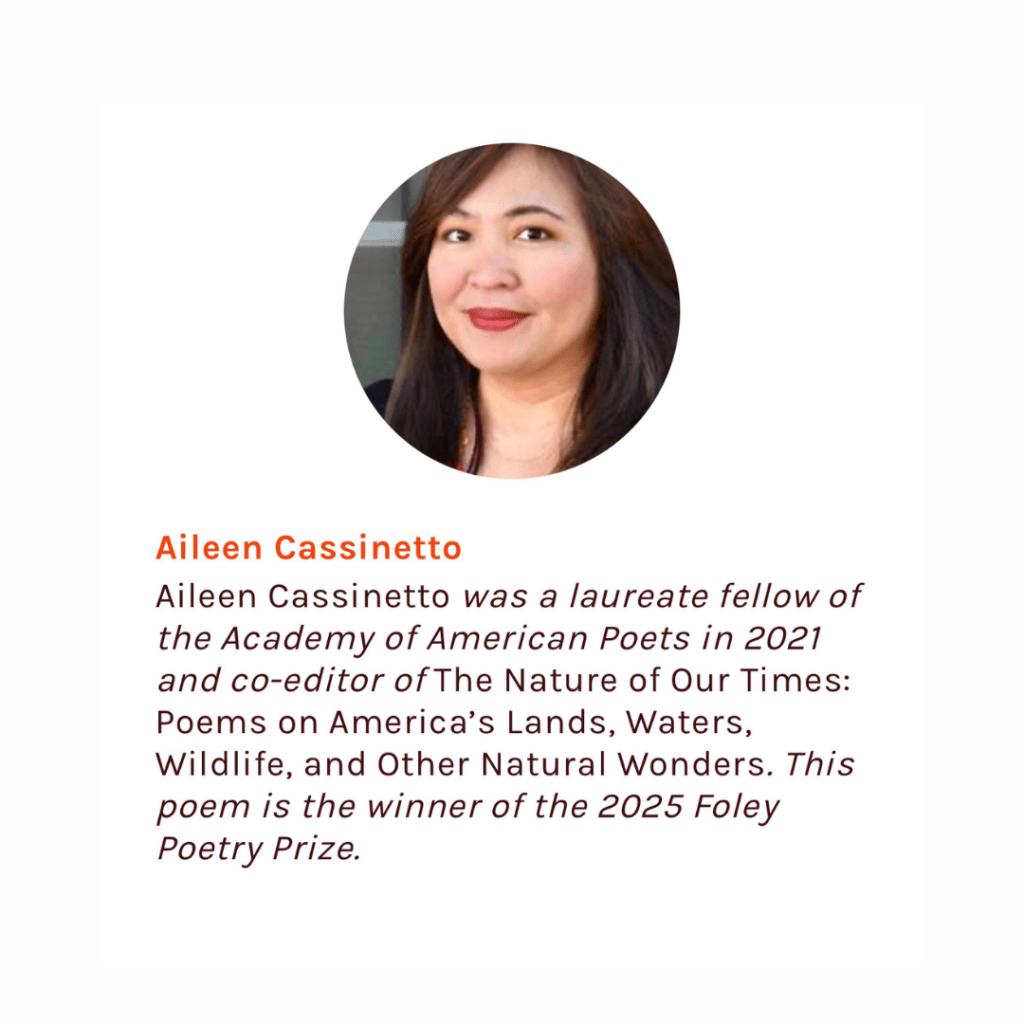
I’m overjoyed to have received this year’s Foley Prize for Poetry. A heartfelt thank you to the judges for the care and attention they gave to my work, and congratulations to America Magazine on its 116th year of publishing poetry and other commentaries.
“CATALOG OF CURES IN ORDINARY TIME, our unanimous winner, features a grief-stricken speaker who draws the reader into a garden that is both real and metaphorical. There, she tends to memory as much as to soil. The poem is elegant in its restraint, exploring the speaker’s grief over her father’s death through the sensory language of a garden. Tonally assured and environmentally attuned, it stands as a quiet monument to how grief endures through motifs the deceased leave behind. We hope that in your celebration of our Foley winner, you also allow this poem to gently guide you through the loss of our Holy Father, Pope Francis.” —Grace Lenahan
“I have always been fond of Edward Hirsch’s idea that a poem is a message in a bottle. That message has to be written. It’s urgent! And it has to be shared; otherwise it could just stay with the poet. But the chances that the poem will find the right reader seem so steep—it is such a huge world, after all. Still, the poet sends the message out into the world, which is an act of faith, one that is realized the moment the reader picks up the poem and starts to read. Aileen Cassinetto’s “Catalog of Cures in Ordinary Time” establishes that necessary urgency in the first line and maintains it throughout the remaining 27. As the speaker works through her grief—the loss of her father—the readers work through their own past, present and future griefs.” —James Davis May
“The topic of a poem may be grief or death, but, in a way, the topic is beauty. It always is. After reading a poem, if we end up remembering only that the poet had a sad thing happen to them, then maybe we have simply heard a confession, have taken a moment or two to feel bad for the author and then moved on. But if we come away with a sense of the beauty of the poem, if it takes our breath away, if it moves us, if the style and structure do something to us, even if we simply enjoy it, the poem has widened out from mere confession of another’s experience to a universal experience in which we can share.” —Joe Hoover
 Aileen Cassinetto